19 January 2026
Natural systems and processes are all interlinked with changes to our climate directly and indirectly influencing the natural world. So too are our systems and processes; all human societies and economies are fundamentally underpinned by nature. Yet nature is treated as an externality, the exploitation of which is largely considered inconsequential to how we value commodities and services. In doing so, we undermine the thing on which we depend the most – our natural world.
The current linear economic model is ultimately unsustainable and we are seeing the underpinning natural systems and processes begin to unravel as soils become increasingly unproductive and water supply struggles to meet demand.
In terms of climate, the concept of embodied carbon is reasonably well known and understood. Embodied carbon is all of the CO2 emitted during the production of a material, including the emissions from extraction, transport as well from the production process.

When it comes to solutions for the natural environment, we first need to adopt a common and comprehensible language and suitable frameworks to combat this issue. Borrowing the ‘embodied’ concept from carbon and applying it to nature is therefore a critical step in internalising outcomes for nature at a systems scale.
Embodied nature describes components of the natural world that are lost to allow the existence of a material, activity or behaviour. Impacts may occur through extraction, manufacturing, transport or the operational lifetime of a project. Thinking in these terms opens the door to consider whole life nature impacts and, importantly, find links for how these impacts relate to humanity’s nature-related dependency.
This is a huge step-change for how development is usually considered in terms of its ecological impact. Ecological surveys and assessments focus entirely on the red line, on those habitats and species that will directly be affected by the development. There was no previous method of determining the impact of the development itself in terms of material production and transport and the impact of that on the natural environment beyond the red line boundary.
This approach ignores the majority of the nature-related impacts that occurs up and down the value chain. Measuring embodied ecological impacts is a way to address this.
We can do this a number of ways, some which specifically seek to quantify the impacts and some which rely on more qualitative judgement-based approaches. The most common emerging approach to quantification is to estimate ‘endpoint’ nature impact through the measurement and translation of ‘midpoint’ impact pathways. In other words, if we can measure the area of land impacted, the carbon released, the water used, the pollution emitted, etc., then we begin to gain an understanding of how we shape the environment and in turn the ability for nature to exist. Several models then allow for these midpoint impact measures to be translated to an endpoint nature impact, using life cycle assessment (LCA) techniques, as demonstrated in Figure 1.
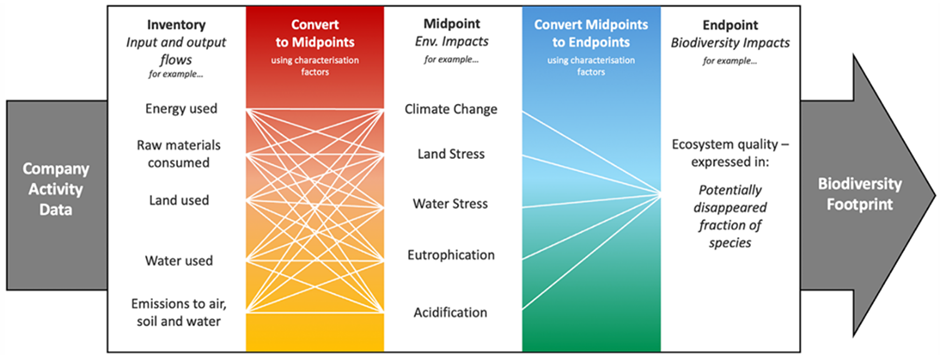
The output is typically expressed as ‘potentially disappeared fraction of species,’ referred to as ‘PDF’ and most commonly reported over a unit area and period time, i.e., ‘species.year’ or ‘species.m2.year,’ which represents the fraction of species locally lost due to a pressure.
To contextualise this briefly, say the embodied ecological impact associated with the amount of steel going into a development was calculated at 25,000 PDF.m2.year. This equates to the steel causing the complete disappearance of species (100% PDF) across 25,000m² for one year. This does not mean that 25,000 species disappeared; it is a weighted measure of potential fractional loss × area × time.
We could also think of it as:
• A 10% PDF (10% species potentially disappeared) spread over 250,000m² for one year.
• A 5% PDF over 500,000m² for one year.
• A 1% PDF over 2.5million m² for one year.
Or even as:
• ~3.5 football pitches of complete species disappearance for one year.
The key is that measuring the impact in this way brings embodied ecological impact into spatial terms and supports comparison between materials/project options. Through this approach we can measure the embodied nature cost of a tonne of steel at a global scale, just as we can the embodied carbon impact. We can then quantify our direct, on-site as well as our indirect, off-site impacts.
Whilst such approaches have caveats and limitations, their reliability is growing and their application allows for informed decisions to be made that result in measurable reductions in supply chain impact. By measuring, even imperfectly, we can draw on expertise and apply the insights to inform alternative, less impactful design and material use decisions – even applying the principles of the mitigation hierarchy to nature throughout the value chain.
Taking this more life-cycle-oriented approach has parallels with carbon, which will help people to come to terms with – and implement – these concepts and practices. Just as consideration of embodied carbon can help to chart a path towards net zero or carbon neutrality, consideration of embodied nature can support the journey towards nature positivity.
If we continue to think about nature impacts in terms of those occurring within the site or within a small zone of influence (e.g., 1km, 2km, 5km etc.), then we will continue to contribute to ecological degradation and biodiversity loss at a global scale. By bringing embodied ecological and biodiversity impacts into scope, we can better understand how to manage, mitigate, reduce and account for them, all of which presents a considerable step towards a more nature positive future.
* Bromwich, et al. (2025) Navigating uncertainty in life cycle assessment-based approaches to biodiversity footprinting. Emerging Methods in Business and Biodiversity, 2025, 00:1-18. Page 3.